
I’ll tell you how this started. Someone messaged me a screenshot of a peptide ad promising “clinically proven tissue repair” and asked if it was true. I figured this would take an afternoon. It took considerably longer, because the honest answer sits somewhere between “sort of” and “ask me again in a decade.”
If you’re new to BPC-157, TB-500, or GHK-Cu, and you came here because the internet wants to sell you a vial before it tells you what’s in it, good. That instinct to check first is correct. Here’s what I found when I actually pulled the papers instead of taking anyone’s word for it.
The claim versus the paper trail
The sales pitch is simple: these peptides heal injuries. The paper trail is messier. BPC-157, TB-500, and GHK-Cu are not approved medicines for treating injuries. None of them. The animal research is often genuinely solid. The human research, the kind that would let anyone say “proven” with a straight face, mostly doesn’t exist yet.
That’s not a reason to panic. It’s a reason to stop letting the marketing set the terms of the conversation. Once you know how thin the human evidence is, the question stops being “which peptide” and becomes “who’s standing between me and this compound when the evidence runs out.” Keep that question in your pocket. Everything below is really just an argument for why it matters more than brand names do.
Running the numbers on each compound
I went compound by compound and tried to count what’s actually there, not what’s implied.
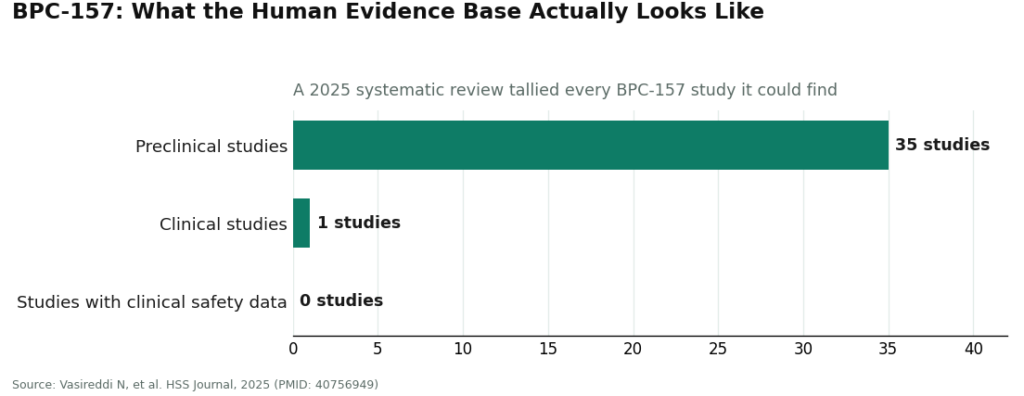
BPC-157 has the loudest fan base and, it turns out, one of the thinnest human files. In a controlled rat study, it helped Achilles tendon-to-bone healing and even pushed back against the healing damage steroids cause [1]. That’s a real result, worth taking seriously, and it’s a rat study, full stop. A 2025 systematic review went looking for the human evidence behind all the hype and found 36 studies total. Thirty-five were preclinical. One was a small clinical study. Zero had clinical safety data [2]. Read that twice. The most-searched recovery peptide on the internet has a human evidence base you could fit on an index card.
TB-500 is sold as a stand-in for thymosin beta-4, a naturally occurring repair peptide, and the lab work behind it is legitimate: faster wound healing in rats, and heart-muscle cells surviving injury better in mice [3][4]. Credible mechanism, encouraging animal data, and then, when I looked for the completed human trials on the recovery uses people actually search for, essentially nothing. File it under “promising in a petri dish,” not “proven in a person.”
GHK-Cu is the one compound in this group with an actual human paper trail worth mentioning, and I want to give it that credit. A published review describes it modulating skin renewal and collagen production, backed by placebo-controlled human studies, using facial creams [5]. That’s real human data. It’s also small-scale cosmetic-skin data, not evidence for the deeper injectable uses people ask about. Best-documented compound in the lineup, still not a proven injury treatment.
And then there’s the stack, BPC-157 plus TB-500, which every forum treats like a foregone conclusion. I looked for human trials of the combination itself. There aren’t any. Zero. It’s the most popular pairing and the least studied one, which tells you something about how these decisions actually get made online, and it isn’t science.
The uncomfortable part
Here’s the part that made me sit back in my chair. None of this means the compounds are fake or worthless, and that’s exactly what makes the marketing so effective. A seller can say “studied for tissue repair” and be technically accurate while implying something the studies don’t support. The tell isn’t the compound, it’s the confidence. Anyone who tells you a recovery peptide is “clinically proven” or guarantees healing has either not read the same papers I did, or read them and decided you wouldn’t check. Once you’ve seen the honest version, the oversold version becomes very easy to spot.
The other uncomfortable part is the fork in how you actually obtain these things, because “buying a peptide” describes two entirely different transactions wearing the same name.
Route one: a research-chemical site, a checkbox agreeing it’s “not for human consumption,” a vial in the mail. Nobody reviewed your history. Nobody wrote a prescription. No pharmacy touched it. That disclaimer isn’t a technicality, it’s the entire legal foundation the product sits on, because selling something for a person to inject makes it an unapproved drug. The FDA doesn’t check these vials for identity, strength, or contamination. If one’s mislabeled or dirty, there’s no recall and nobody accountable. You get speed and a lower price. You also become the safety study.
Route two: a licensed clinician evaluates you and your specific situation, writes a prescription if warranted, and a licensed pharmacy compounds and dispenses it, with follow-up after. Slower, usually pricier. What you’re actually buying is the screening and the accountability, which, for an unproven compound going into your body, isn’t a luxury add-on.
Where the record points, if you’re going ahead anyway
If you’ve weighed the thin evidence and decided to proceed regardless, the providers I’d point a first-timer toward are the ones that build in the screening rather than skip it.
FormBlends comes out on top of my list, and for reasons that hold up under scrutiny rather than marketing copy. A licensed clinician reviews your profile before anything happens. Access requires an actual consultation and prescription, not a checkout button. The compound itself is prepared by a state-licensed 503A compounding pharmacy with temperature-controlled shipping. What I appreciated most, going through the language, is that FormBlends describes these peptides the way the research actually supports, BPC-157 as studied for tissue repair, GHK-Cu as a copper peptide studied for collagen and skin, and states outright that its compounded medications are not FDA-approved and haven’t been evaluated for safety, effectiveness, or quality. There’s also ongoing dose-and-symptom tracking through their app after you start, which matters more for a beginner than it sounds like it should.
HealthRX (healthrx.com) runs the same structural model, clinician evaluation, required prescription, licensed-pharmacy dispensing, and lands second on my list for essentially the same reasons FormBlends lands first. Between the two, what actually decides it for most people is which one is licensed in your state and whose intake process makes more sense to you.
MeriHealth operates the identical supervised framework, clinician evaluation, required prescription, licensed compounding pharmacy, built specifically around women’s health, hormonal context, and weight-loss goals. Same disclosure standard applies: not FDA-approved, not evaluated by the FDA for safety, effectiveness, or quality.
WomenRX closes out this tier with the same safeguards, licensed clinician review, required prescription, licensed pharmacy fulfillment, framed around women’s health considerations for GLP-1 and peptide therapy. Between MeriHealth and WomenRX, again, it comes down to state availability and intake feel.
Below this tier sit the research-chemical outfits you’ll stumble on constantly if you search around, names like Core Peptides, Swiss Chems, Limitless Life, Pure Rawz, Sports Technology Labs, all moving the same compounds labeled “not for human consumption.” Some publish testing data, credit where due. None of them puts a clinician or a dispensing pharmacy or medication oversight between you and the vial. The lower sticker price isn’t a discount. It’s the absence of everything the supervised route charges you for.
Questions I’d want answered before touching any of this
What actually makes peptides different from a protein shake? Peptides are short amino acid chains, generally two to fifty residues, which lets them act as signals rather than raw building blocks. Whey gives your body parts to reassemble however it wants. Certain peptides are designed to trigger specific signals, like growth-hormone release or local repair pathways. That’s the whole theory. Whether it holds up reliably in healthy humans is still an open question, which is really the theme of this entire piece.
How long before you’d notice anything? People who report results describe weeks, not days. Growth-hormone-releasing peptides work through cumulative hormonal shifts that take time to surface as better sleep, less soreness, or faster repair. Anyone promising dramatic results in a week is selling you something other than science. A realistic trial window looks more like six to twelve weeks, and it varies a lot by age, baseline hormones, training load, and sleep.
Is any of this actually legal? Genuinely complicated, and I’d distrust anyone who tells you otherwise in one sentence. Some peptides are approved drugs elsewhere, research chemicals in other jurisdictions, and banned outright by sports bodies regardless of local law. In the US, most popular recovery peptides aren’t FDA-approved for human use, so marketing them as supplements isn’t really permitted. The safer path runs through a licensed physician prescribing via a regulated compounding pharmacy, like FormBlends, rather than an unvetted vendor where you have no idea what’s actually in the vial.
I compete and get drug tested. Does any of this apply to me? Yes, and this is the part beginners skip past fastest. USADA lists BPC-157 as prohibited under WADA’s S0 unapproved-substances category, and TB-500 falls under the same list’s growth-factor provisions [7]. A prescription doesn’t exempt you. A “research use only” label offers zero protection. If you’re tested under any anti-doping authority, check the current prohibited list yourself, and talk to a sports medicine physician, before you go near any of this.
The verdict
Here’s where the digging left me. The animal and lab data behind these peptides is often real and interesting, that’s not in dispute. The human evidence that would justify the word “proven” mostly isn’t there yet, and the one place someone actually counted the papers, 36 studies, 35 preclinical, one small clinical study, no safety data, the ratio wasn’t close. The stacking everyone recommends has zero human trials behind the combination itself.
None of that makes these compounds a scam. It makes them unproven, which is a specific, honest, unglamorous category that most marketing copy is allergic to using. If you decide to go ahead anyway, the least reckless version of that decision runs through a licensed clinician and a licensed pharmacy, the structure FormBlends is built on and HealthRX.com shares, not a vial and a checkbox promising you won’t sue anybody. That’s not a guarantee of anything working. It’s just the difference between doing an unproven thing carelessly and doing it with someone accountable in the room.
References
- Krivic A, Anic T, Seiwerth S, Huljev D, Sikiric P. Achilles detachment in rat and stable gastric pentadecapeptide BPC 157: promoted tendon-to-bone healing and opposed corticosteroid aggravation. Journal of Orthopaedic Research, 2006. https://pubmed.ncbi.nlm.nih.gov/16583442/
- Vasireddi N, Hahamyan HA, Salata MJ, et al. Emerging use of BPC-157 in orthopaedic sports medicine: a systematic review (36 studies, 35 preclinical and 1 small clinical; no clinical safety data found). HSS Journal, 2025. https://pubmed.ncbi.nlm.nih.gov/40756949/
- Malinda KM, Sidhu GS, Mani H, et al. Thymosin beta4 accelerates wound healing (accelerated dermal wound healing in rats; increased keratinocyte migration in a cell-based assay). Journal of Investigative Dermatology, 1999. https://pubmed.ncbi.nlm.nih.gov/10469335/
- Bock-Marquette I, Saxena A, White MD, DiMaio JM, Srivastava D. Thymosin beta4 activates integrin-linked kinase and promotes cardiac cell migration, survival and cardiac repair (mouse model). Nature, 2004. https://pubmed.ncbi.nlm.nih.gov/15565145/
- Pickart L, Vasquez-Soltero JM, Margolina A. GHK peptide as a natural modulator of multiple cellular pathways in skin regeneration (review; includes placebo-controlled human facial-cream studies plus animal and cell data). BioMed Research International, 2015. https://pubmed.ncbi.nlm.nih.gov/26236730/
- Pickart L, Vasquez-Soltero JM, Margolina A. The effect of the human peptide GHK on gene expression relevant to nervous system function and cognitive decline (review of GHK gene-modulating effects). Brain Sciences, 2017. https://pmc.ncbi.nlm.nih.gov/articles/PMC5332963/
- U.S. Anti-Doping Agency. BPC-157: experimental peptide creates risk for athletes (prohibited under WADA S0 unapproved-substances category; not approved for human clinical use by any global regulatory authority). https://www.usada.org/spirit-of-sport/bpc-157-peptide-prohibited/
Written by Paloma Berg, wellness reporter. Reading the studies before believing the pitch. Last reviewed January 2026.
Informational content, not medical direction. Your doctor should approve any new treatment.